
Your CustomerGauge platform comes with a standard set of drivers, that can (and should!) be adjusted based on your ongoing Customer Journey Mapping. Additional questions from a previously executed survey can also be helpful in defining your drivers. There are a few rules to go by when creating the perfect driver set.
Directions
Defining Drivers
- Your drivers should follow the Ongoing Customer Journey. This means that any initial consideration- and contract-phases do not need to be represented. This will make the drivers very relevant to the customer’s experience.
- Drivers should use terms that are understandable both internally (when reviewing the results) and externally (avoid the use of specific internal terms) and consider the language level of your participants. Are they getting the survey in English and are they likely not native speakers? Make sure to adjust accordingly.
- Keep drivers neutral. The sentiment should be reflected in the question, which can be adapted based on NPS score (Example: For promoters: What are we doing particularly well? For Passives/Detractors: What can we improve?). A good driver would be 'Customer support', not 'Customer support is good' or 'Customer support should be better'.
- The primary drivers should represent main categories (like 'Customer support'). Secondary drivers can be used to provide further differentiation under the primary category (like 'Issue awareness' or 'Solution timeliness').
- Don’t make the Driver list too long. We recommend having a maximum of 5 primary drivers, and a maximum of 5 secondary drivers below each primary driver.
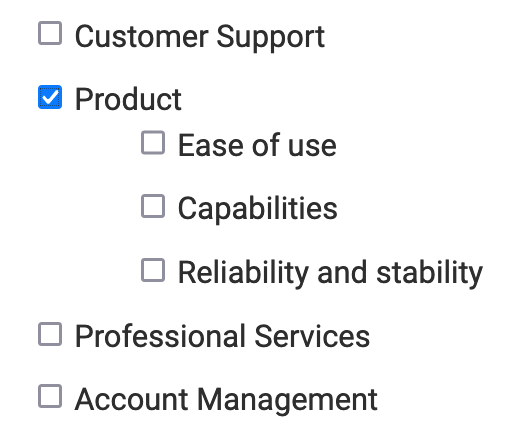
Example:
Support
- Representative friendliness and helpfulness
Should instead be split up:
- Representative friendliness
- Representative helpfulness
Or rephrased:
- Representative attitude
Avoid Repetition:
In the example of CustomerGauge:
CustomerGauge Support
- CustomerGauge ticketing system
- CustomerGauge support articles
- CustomerGauge in-tool help buttons
All the above can be easily replaced with "Support" as shown below:
Support
- Ticketing system
- Manuals
- In-tool help buttons
This is because the customer will already know they are answering the survey about your company - and that the subdrivers are related to the primary Support driver in this example.
Do not use ‘Other’ as a primary or secondary driver as it adds no value to reporting, and therefore no action can be driven.
The customer comments will allow you to identify any missing drivers, and they can always be added later.
Similarly, you should avoid adding a primary or secondary driver of 'Value (for the money)' to ask about the cost effectiveness of your service/ product. This is because this element should be holistically addressed through other specific drivers. Having this stand-alone driver does not provide additional actionable insights.
Note: Do you feel like you’d need a third layer of drivers? That would be a touchpoint survey. Your primary driver could become a (perhaps transactional) survey in itself, with its secondary drivers serving as the primary drivers in that touchpoint survey.
Example of Touchpoint survey driver:
Your customer created a ticket that has now been solved. Your survey looks something like this:
"Based on your experience with Company’s X support environment, how likely are you to recommend us to a colleague or business acquaintance?"
Drivers would be:
Ticketing system
- Access
- Alerts
- Time to solution
- Friendliness
- Support articles
- Search
- Depth
Avoid the use of articles:
Example:
The Support tool
- The ticketing system
- The manuals
- The in-tool help buttons
Should be replaced with:
Support
- Ticketing system
- Manuals
- In-tool help buttons
Note that the drivers are not a mandatory question. If you follow the above instructions, and your drivers are closely following the ongoing customer journey (and will therefore feel very relevant to your customer), we see an average click rate of 80%.
So, why not make it mandatory and capture the other 20%?
The reason is very simple. As part of this program, your organization will look at the aggregated feedback and make investments in improving the company based on the driver feedback. If customers are forced to select a driver, they might choose random options - skews your data and may misdirect your resources.
Some customers may even abandon the survey as a result of the mandatory element. While this improves the reliability of your driver data, it negatively impacts your ability to capture overall sentiment and initiate a conversation - through their score along with, potentially, comment and follow-up request).